The Sky Is the Limit: Gift’s Journey from Rock Drill Operator to Boilermaker
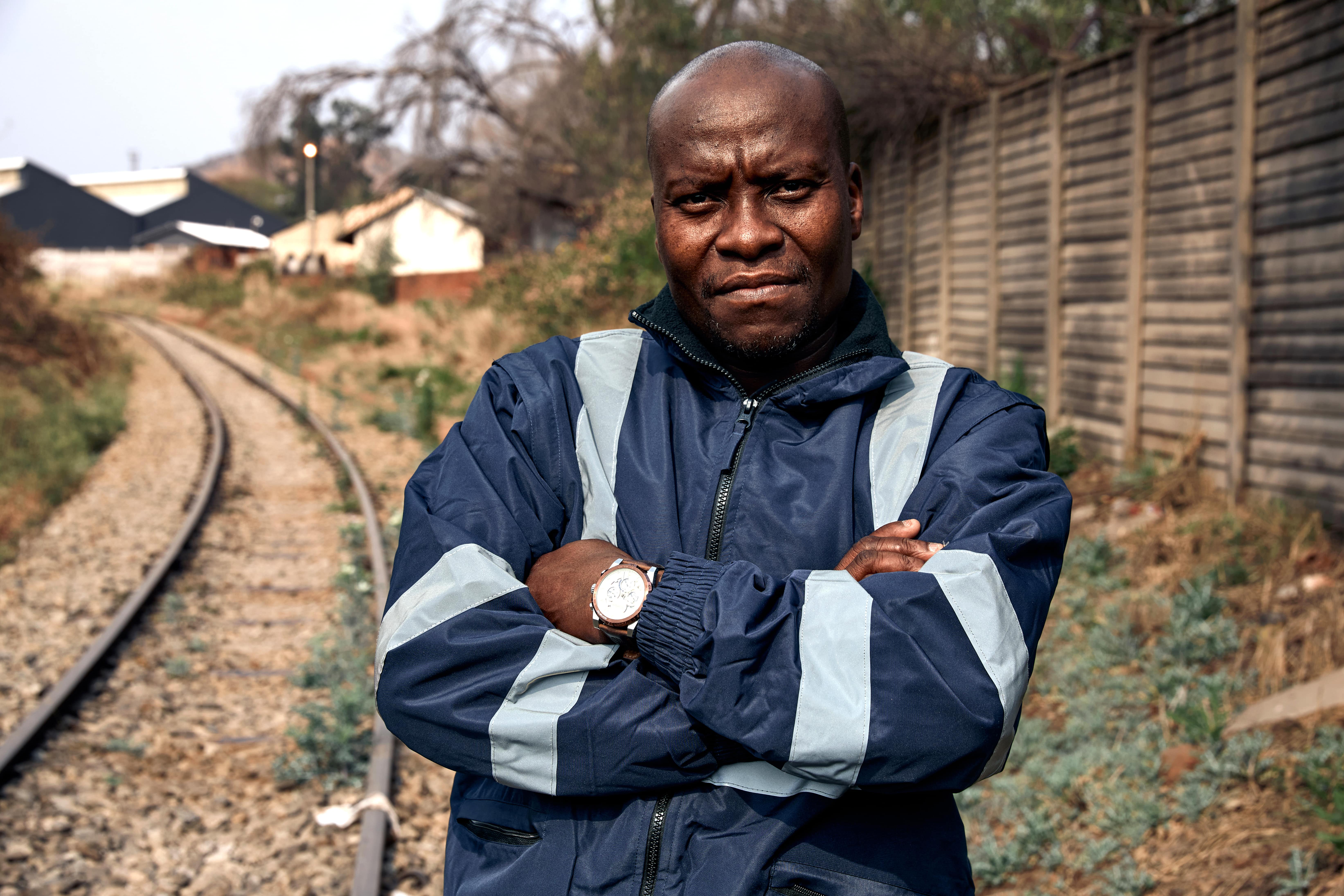
When Gift Sidumedi looks back on his life in Modikwe, a rural village near Brits, he remembers the simplicity of childhood, and the hunger to be more. “Growing up in the rural areas is tough,” he says. “You don’t have much access to things like in the suburbs. You look at the man next door who works at the mine, and you say, I want to be like that guy.”
That childhood dream eventually carried him to Rustenburg, where he began one of the longest and hardest journeys of his life. In 2000, Gift began his career at Mafikeng Rasimone Mine, which had only recently opened. His path through the mining industry was steady but slow. In 2000–2006 he was a Rock Drill Operator. In 2006–2010 a Winch Operator. In 2010–2016 an Explosives Issuer and in 2016–2020 an Engineering Assistant
The early years were particularly hard. “At first, it was tough for me. I told myself, let me take this journey and see where it’s going to lead me.” He had no guarantees of progress, but he kept applying for learnerships year after year, hoping that one day an opportunity would arrive.
That opportunity came in 2020. At a NUM mass meeting, Gift heard about the Elijah Barayi Memorial Training Centre (EBMTC). “When I first heard about it, I said, this is an opportunity I can grab. I applied immediately,” he recalls.
The programme was not smooth sailing. COVID-19 struck soon after, delaying training by nearly a year. For Gift, who had already waited almost two decades, the setback was agonising. “I told myself, is this going to happen again? I prayed almost every day for COVID to end so we could continue.”
Despite the delay, he stayed determined, holding onto the belief that his breakthrough would not be taken away this time. When the day of completion came, Gift’s emotions overwhelmed him. “The day I completed, I was emotional. I even cried,” he admits. “I said, at least I’m going somewhere.”
The tears came from years of rejection. “Since 2000, I had applied for learnerships every year. Nothing ever happened. EBMTC came to the rescue. I said, thank you, God.” Graduating as a boilermaker wasn’t just a qualification. It was proof that his persistence had finally paid off.
Today, Gift proudly works as a boilermaker at Impala Platinum. But his ambitions don’t stop there. “The sky is the limit,” he says confidently. “I’ll be starting the foreman route now. From foreman to engineering overseer, and then to engineering manager. When you have the trade, it’s easy to go to the next stage—you can manoeuvre around.”
For Gift, the trade certificate is more than a piece of paper. It is a key that opens doors he once thought were closed forever. Gift ends his story with heartfelt appreciation for the National Union of Mineworkers. “NUM is here, NUM is doing well, NUM is good. I am the working example of NUM’s benefits, and I’m truly happy for that.”
From a rural boy in Modikwe dreaming of becoming like the mineworker next door, to a qualified boilermaker with ambitions to become an engineering manager, Gift’s story is a testament to perseverance and opportunity.
He embodies the essence of MIT and MIC’s legacy of turning the struggles of mineworkers into platforms for transformation. His tears at graduation capture what these opportunities mean. Decades of waiting, finally rewarded. As Gift puts it simply: “The sky is the limit.”
When Mandla first joined the industry, many of his colleagues could not read or write. Payslips, medical reports and contracts were confusing and intimidating. Adult Basic Education and Training (ABET) changed that. Through ABET classes, mineworkers learned to sign their own names, understand the documents that governed their lives and participate more confidently in union meetings and community decisions.
“Education is a mineworker’s widest dream,” Mandla says. “ABET gave workers dignity.” But ABET was only the beginning. As the NUM leadership worked with MIT to establish the JB Marks Education Trust Fund, a new layer of opportunity opened for mineworkers’ children – access to colleges, universities and professional careers that had once felt out of reach.
Today, Mandla proudly tells the story of families where the parent started out illiterate, and the child became the first graduate – in some cases, going all the way to a PhD. What once seemed impossible for a mining family has slowly become part of a new normal: children of rock drill operators, cleaners and general workers becoming doctors, engineers, teachers, accountants and researchers.
For Mandla, graduation ceremonies are the most emotional part of the journey. He has watched parents travel long distances in their best clothes to sit in university halls they never imagined entering. He has seen the look on a mother’s face when her child’s name is called, and the realisation that years of sacrifice underground have helped unlock a different life above ground.
“One graduate changes the story for a whole family,” he explains. “You can see younger siblings saying, ‘If my sister can do it, so can I.’ Education doesn’t just lift one person – it lifts a household and, over time, a whole community.”
Mandla also understands that this progress is fragile. The Trust relies on contributions and careful management of resources. Economic pressures and rising costs of study threaten to shut the door on many talented young people. That is why he argues that strengthening institutions like MIT and JB Marks is not a luxury – it is an investment in South Africa’s long-term stability and growth.
In mining towns and labour-sending areas, the ripple effect is already visible. Former beneficiaries return as professionals, mentors and role models. Some sit on boards, others teach at universities or run businesses that employ more people. Each success story is a quiet answer to the question of whether mineworkers’ sacrifices have been worth it.
From ABET classrooms on mine property to convocation stages at universities, Mandla has watched education change people’s confidence, language and possibilities. Where once a thumbprint stood in for a signature, now degrees hang on walls. Where once mineworkers felt shut out of decisions, their children now sit at tables where policies, budgets and strategies are shaped.
“With JB Marks, there is light, there is a future,” Mandla says. His story – and the stories of thousands of families like his – is a reminder that when workers organise to invest in education, they are not only changing their own lives. They are rewriting what is possible for the generations that follow.